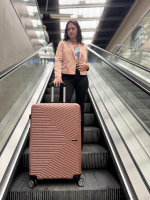
Which suitcase to choose? Fabric, shell and what material? ABS, polycarbonate, polypropylene or polyester? Each material has something to offer and everyone is looking for the ideal luggage for themselves. Price, durability, weight or accessories can be the deciding factor. Below you will find out what the materials used are and their advantages.
Materials for suitcases:
Shell:
ABS (acrylonitrile-butadiene-styrene)
This is a copolymer that is very common in shell luggage. Suitcases made of ABS are characterised by their resistance to damage even at low temperatures. This material absorbs shock. The price of suitcases made of this material is also an indisputable advantage. The disadvantage is that the ABS material can easily crack when roughly handled, especially if it is made of a thin layer.
In our company you can find suitcases made of ABS material only from thick shell with "medium" resistance (we do not sell "very low" or "low" resistance).
Acrylonitrile butadiene styrene (abbreviated ABS) is an amorphous thermoplastic industrial copolymer that is resistant to mechanical damage. Rigid, tough, depending on the type, resistant to low and high temperatures, low water absorption, non-toxic. Resistant to acids, hydroxides, hydrocarbons, oils, fats.
It can be processed up to a temperature of 280 °C. At higher temperatures it starts to decompose. Its density is 1 045 kg/m3 and shrinkage 0,3-0,7 %. The heat resistance of the products is up to 105 °C.
The most important applications are in furniture, bottles, travel cases, 3D printing and edge fixing in straight and shaped laminated chipboard. It is also used to make most LEGO bricks and airsoft guns.
Polycarbonate
It has very similar properties to ABS, but with the added benefit of high resistance to temperature and cracking. If you try to dent polycarbonate, it will definitely not crack. Thanks to its perfect elasticity, it will only bend and return. Polycarbonate suitcases are among the lighter ones and are therefore ideal for airplane holidays where weight plays a role.
In our range you will find mostly polycarbonate suitcases with ABS compound. Only quality made with the latest technology. These suitcases are mostly characterized by their "high" durability.
The name polycarbonate is due to the fact that it is a polymer containing carbonate (carbonate) groups (-O- (C = O) -O-). The balance of useful properties, including temperature resistance, impact toughness and optical properties, makes polycarbonates a widely traded plastic and a so-called technical plastic.
Polycarbonate is a durable material. Although it has high impact resistance, it has low scratch resistance. Therefore, a hard coating is applied to polycarbonate lenses and polycarbonate automotive components. The properties of polycarbonate are comparable to polymethyl methacrylate, but polycarbonate is stronger and lasts longer in extreme temperatures.
Unlike most thermoplastics, polycarbonate can undergo large plastic deformations without cracking or breaking. As a result, it can be processed and manufactured at room temperature using sheet metal techniques such as bending on a bender. Even at sharp angles with a narrow radius, heating does not necessarily occur. This makes it valuable in prototype applications where transparent or electrically non-conductive parts are required that cannot be made from sheet metal. Polymethyl methacrylate, which has a similar appearance to polycarbonate, is brittle and cannot be bent at room temperature.
Polypropylene
This is a lightweight and highly durable material that is safe in the event of contact with fire. For travel cases, the technology used in the manufacturing process is also important. Mostly, this material is processed by Flowlite technology, where the strength of the material is not lost when processing even thin parts. The main advantage of polypropylene is that it can be produced in a myriad of colours.
In our offer you can find top quality Polypropylene suitcases characterized by resistance: "high" or "very high"
Polypropylene (PP) is a thermoplastic polymer of the polyolefin group, one of the most common plastics, used in many sectors of the food and textile industries and in laboratory equipment. It is sold under the trade names Tipplen, Tatren, Mosten, etc.
Polypropylene has similar physico-chemical properties to polyethylene. It becomes brittle at low temperatures, softens around 140-150 degrees Celsius, and melts around 160-170 degrees Celsius. It is resistant to oils, organic solvents and alcohols, dissolves well in xylenes or tetrahydronaphthalene. Polypropylene has very good chemical and mechanical resistance.
Textiles:
Polyester
Fabric made of synthetic fibres, the quality of which may vary from brand to brand. Depending on the processing technology. The best indicator of the strength of the material is the density of the weave and the thickness of the fibres used.
Polyester fibers (international abbreviation PES) are synthetic products from a group that includes textile fibers made from polyethylene terephthalate (PET), polybutylene terephthalate (PBT) and polytrimethylene terephthalate (PTT). The term polyester fibers generally refers to products made from PET, from which the vast majority of fibers are derived
We offer well-made, practical textile polyester suitcases, also suitable for air transport.
Polyester fibres can be found in virtually all textile products.
The most important positive properties include:
High resistance to light, weather and microorganisms.
Low moisture resistance.
The feel and sheen is very similar to natural silk.
Nylon
Nylon has been used for luggage for a long time. This material will be easy to keep clean. Nylon offers a wide range of colors.
Nylon is the first synthetic polymer and the first synthetic fiber to be made directly from coal, water and air and it has been a commercial success.
Polyamides have a good affinity for dyes, little light and weather fastness, and a tendency to develop static charge.
The disadvantage of nylon is its very low availability and therefore high price.
Aluminium
Aluminium luggage should definitely be mentioned as a separate category. It is mainly an alloy of aluminium and magnesium, which guarantees excellent durability of the luggage. Aluminium is a very light metal used in the aerospace industry since its beginning. The disadvantage is the possibility of denting the suitcase, especially in air transport.
Leather
A leather suitcase is first and foremost a stylish piece of luggage where we look at its appearance. Leather suitcases are prone to drying and cracking. The owner needs to take care of them to keep them looking like new. The higher purchase price and weight of the suitcase itself can also be a disadvantage. Thus, they are not suitable for air travel, where we look at every kilo.